3.28.2009

Chickpea, Tomato, & Barley Soup

Chickpea, Tomato, & Barley Soup

Did You Know? Grains found in pits and pyramids in Egypt indicate that barley was cultivated there more than 5000 years ago. The most ancient glyph or pictograph found for barley is dated about 3000 B.C. In fact, Historians report that up until the 16th century, barley was the most important grain on the European continent. It was also used as currency and as a measuring standard.

Trying to keep my promise of cooking more from the magazines I subscribe to, this next recipe is from a past issue of Body and Soul, a division of Martha Stewart. If you're not familiar with the magazine, I definitely recommend checking it out. It's full of useful health and wellness information, workouts, recipes, and sustainable living advice, but with that Martha Stewart flair we all love. The pictures are beautiful, and the companies and products featured somehow seem to make their way onto my grocery list each and every week.

This particular soup recipe has become a family staple ever since I first made it many months ago. I don't know why I never shared it here, but I'm guessing it's because I never got around to photographing it before the pot was empty. I'm always looking for thick and hearty soups to prepare. Something that will fill me up on its own, and not as a side to some other dish. With 19 grams of protein, and 12 grams of fiber, this soup is nutritious and satisfying.


Chickpea, Tomato, & Barley Soup

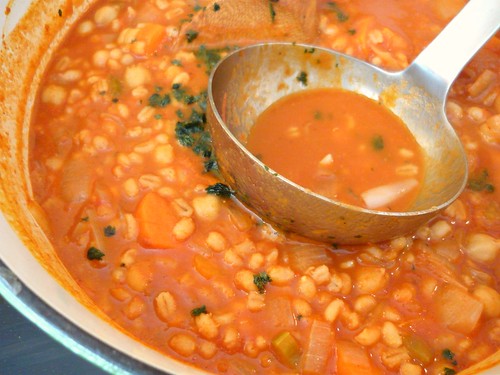
The original recipe calls for spelt, but I substituted that with barley since its what I had on hand. We all like the flavor so much, I have yet to make the spelt version. That, and I've never seen spelt offered at any of my local grocery stores. I also top it off with cilantro instead of parsley. Mainly because of my recent obsession with this wonderful herb. Other than that, I followed the recipe pretty much to the T. Starting any soup with a mirepoix is almost a guarantee that you'll end up with a flavorful bowl. And the creamy chickpeas work wonderfully with the nutty barley and the spicy tomato broth. It also makes for great leftovers. Just make sure you have some extra broth on hand, because it thickens up substantially in the fridge. Served with a nice salad and fresh loaf of bread, lunch could not have been better.
Chickpea, Tomato, & Barley Soup

Chickpea, Tomato, & Barley Soup
Adapted from Body and Soul Magazine

1 cup barley
2 tablespoons olive oil
1 medium onion, chopped
2 carrots, halved lengthwise and cut into 1/2-inch lengths
2 celery stalks, diced
4 garlic cloves, chopped
Coarse salt and ground pepper
2 bay leaves
2 teaspoons sweet paprika
1 teaspoon ground cumin
4 cups vegetable broth
1 can (14 1/2 ounces) crushed tomatoes
1 can (15 ounces) chickpeas, drained and rinsed
1/4 cup chopped cilantro, for garnish

Rinse barley clean under running water. Place in a medium bowl and cover with cold water. Let soak for 1 hour; drain.

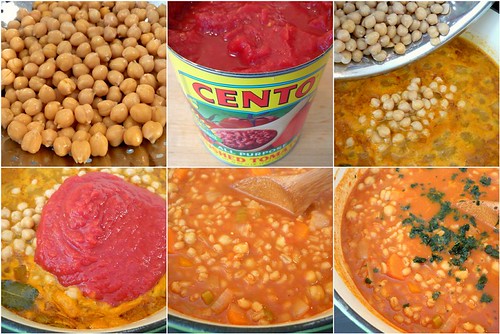
In a 5-quart Dutch oven or large soup pot, heat oil over medium. Add onion, carrot, celery, and garlic. Season with salt and pepper and cook for 5 minutes. Add bay leaves, paprika, cumin, barley, broth, and 1 cup of water. Bring to a boil, reduce to a simmer, and cook for 30 minutes or until barley is tender.

Add tomatoes and chickpeas and cook for 20 minutes or until flavors have blended. Discard bay leaves. Sprinkle with chopped cilantro before serving.


3.24.2009

Sydney's Double Chocolate Layer Cake

Double Chocolate Layer Cake

Did You Know? At the time Marie Antoinette uttered the infamous quotation "let them eat cake," the word "cake" did not refer to the familiar dessert item that the modern-day French call le gateau. The operative term was brioche, a flour-and-water paste that was "caked" onto the interiors of the ovens and baking pans of the professional boulangers of the era. At the end of the day, the baker would scrape the leavings from his pans and ovens and set them outside the door for the benefit of beggars and scavengers. Thus, the lady in question was simply giving practical, if somewhat flippant, advice to her poor subjects: If one cannot afford the bourgeois bread, he can avail himself of the poor man's "cake."

After a ridiculous conversation about boxed cake versus homemade, I decided to put the argument to rest, and convince my skeptical sister that homemade is the only way to go. We often joke about how off her taste buds are, prefering all the cheap, artficial foods over a nice, healhy meal. She says if she knows one thing, it's chocolate cake (something about an entire Entenmann's?). And she was positive the boxed cake was superior to anything I could bake from scratch (she's kind like that). From that statement on, I was on a mad hunt for the ultimate chocolate cake recipe.

High on the list when Googling "chocolate cake," this particular recipe had it's devoted followers. Originally featured in Gourmet, this cake must have been replicated at least a thousand times since. Declared as Deb's favorite, the layered masterpiece I was about to recreate had my approval. And since I had a skeptic on my hands, I had to buy only the finest quality ingredients. So off to Whole Foods I went. Two pounds of Callebaut later, and thirty dollars lighter (well I guess I wasn't thirty dollars lighter - thanks Mom), I was in my kitchen, and ready to conquer the chocolate cake.


Double Chocolate Layer Cake

I was surprised at the amount of hot coffee the recipe called for. I definitely didn't want a mocha-flavored cake, so that made me nervous. I couldn't have been more wrong. The coffee brought out a depth of flavor from the chocolate that I had never tasted before. And that chocolate. I will never go back to Ghirardelli again. The original called for semisweet. But I could only find bitter and milk, so I bought both and combined the two. The end result was truly amazing. Moist, tender crumbs, sandwiched by a rich chocolate ganache. The flavors were beyond complex. And the debate we had on our hands? Long forgotten.

Double Chocolate Layer Cake


Double Chocolate Layer Cake
Adapted from Epicurious via Gourmet, March 1999

Cake Layers
3 ounces fine-quality semisweet chocolate (I used milk chocolate Callebaut)
1 1/2 cups hot brewed coffee
3 cups sugar
2 1/2 cups all-purpose flour
1 1/2 cups unsweetened cocoa powder (not Dutch process)
2 teaspoons baking soda
3/4 teaspoon baking powder
1 1/4 teaspoons salt
3 large eggs
3/4 cup vegetable oil
1 1/2 cups well-shaken buttermilk
3/4 teaspoon vanilla

Ganache Frosting
1 pound fine-quality semisweet chocolate (I used a combo of milk and bittersweet Callebaut)
1 cup heavy cream
2 tablespoons sugar
2 tablespoons light corn syrup
1/2 stick (1/4 cup) unsalted butter


Make Cake Layers
Preheat oven to 300°F, and grease two 10-inch round cake pans. Line bottoms with rounds of wax paper and grease paper.

Finely chop chocolate and in a bowl combine with hot coffee. Let mixture stand, stirring occasionally, until chocolate is melted and mixture is smooth.

Into a large bowl sift together sugar, flour, cocoa powder, baking soda, baking powder, and salt. In another large bowl with an electric mixer beat eggs until thickened slightly and lemon colored (about 3 minutes with a standing mixer or 5 minutes with a hand-held mixer). Slowly add oil, buttermilk, vanilla, and melted chocolate mixture to eggs, beating until combined well. Add sugar mixture and beat on medium speed until just combined well. Divide batter between pans and bake in middle of oven until a tester inserted in center comes out clean, 1 hour to 1 hour and 10 minutes.

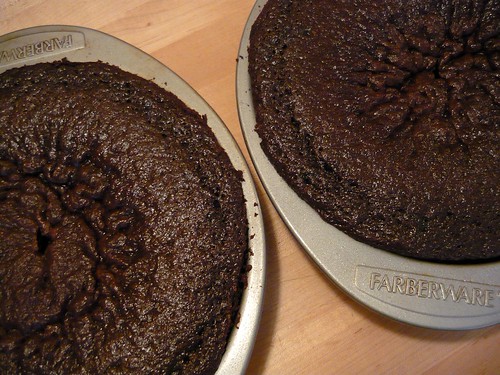
Cool layers completely in pans on racks. Run a thin knife around edges of pans and invert layers onto racks. Carefully remove wax paper and cool layers completely. Cake layers may be made 1 day ahead and kept, wrapped well in plastic wrap, at room temperature.

Make Frosting
Finely chop chocolate. In a 1 1/2- to 2-quart saucepan bring cream, sugar, and corn syrup to a boil over moderately low heat, whisking until sugar is dissolved. Remove pan from heat and add chocolate, whisking until chocolate is melted. Cut butter into pieces and add to frosting, whisking until smooth.

Transfer frosting to a bowl and cool, stirring occasionally, until spreadable (depending on chocolate used, it may be necessary to chill frosting to spreadable consistency).

Spread frosting between cake layers and over top and sides. Cake keeps, covered and chilled, 3 days. Bring cake to room temperature before serving.

Double Chocolate Layer Cake


Back to Top